What Is an AI Operating System for Commerce?
An AI operating system for commerce connects business data, organizational context, analysis, and action. It gives every team a shared intelligence layer rather than another isolated dashboard.
The AI developments worth knowing, what we are learning and building at DataSync, and what businesses should anticipate as AI changes how teams analyze, decide, and operate.
Guides, frameworks, use cases and research on how commerce teams analyze, decide and operate — every article carries one topic, one business outcome and one content format.
Most commerce teams no longer have a data problem. They have a decision problem — and every dashboard added to the estate quietly makes it worse.
An AI operating system for commerce connects business data, organizational context, analysis, and action. It gives every team a shared intelligence layer rather than another isolated dashboard.
More dashboards can increase visibility without improving coordination. Synchronized intelligence connects the metrics, business context, owners, and actions behind each commercial decision.
Commerce AI creates value when data, workflows, and people are designed to work together. The Sync, Simplify, Scale framework provides a practical sequence for building that operating model.
The same commerce data should produce different outputs for different responsibilities. Role-based AI reporting aligns each user’s insights, KPIs, risks, and actions with the decisions they own.
SYNC AI Analist is DataSync’s internal analytics assistant. It evaluates connected commerce data in the context of company goals, user roles, and operating rules to support faster decisions.
A campaign can meet its ROAS target while supporting low-margin products, accelerating stock risk, or receiving credit under an incomplete attribution view. Better decisions connect media performance to commercial reality.
Product prioritization is not a ranking of best sellers. It is a decision about where demand, inventory, margin, media, and customer conditions create the strongest next action.
Inventory risk is created by the relationship between stock, demand, time, and commercial plans. AI can help detect that relationship earlier when the underlying data is synchronized.
Customer feedback becomes more valuable when it is connected to products, channels, returns, fulfillment, and sales. That connection turns sentiment into an operating signal.
Sync AI CX Agent is DataSync’s external customer response infrastructure. It uses approved product data and information sources to manage customer questions consistently at scale.
An executive memo rather than a blog post — what moved in commerce AI, what we shipped, and what to watch. Newest first; every edition opens on LinkedIn.
Every other Tuesday. Roughly a four-minute read, no product pitches.
Subscribe to In-SyncLoading the latest editions…
Setup documentation, not articles. Find your platform, check what it syncs and how often, then follow the numbered steps. No publish dates, no read times — this is reference material.
Authorise DataSync with the platform account. API keys, OAuth or a service user — whatever that platform supports.
Match item codes, warehouses and channels to your DataSync model. Presets exist for the common platforms.
Real-time webhooks where the platform offers them, scheduled batches where it does not. Deltas reconcile nightly.
The platform appears as a source in reports, rules and SYNC AI answers — with its own freshness indicator.
Turkey's largest online marketplace, spanning fashion, electronics, and home goods.
A leading Turkish online marketplace and one of the country's major listed e-commerce platforms.
Amazon's global marketplace, spanning multiple regions and fulfilment models.
A Turkish online marketplace covering electronics, fashion, and general merchandise.
Google's advertising platform for search, display, and shopping campaigns.
Meta's advertising platform across Facebook and Instagram.
Google's web and app analytics platform.
An open, generic automation layer for connecting custom workflows and event triggers.
A Turkish ERP system widely used by small and mid-sized businesses.
A Turkish ERP platform used across manufacturing and distribution businesses.
SAP's ERP platform built for small and mid-sized enterprises.
A Turkish ERP and accounting software provider.
A global e-commerce platform for building and running online stores.
A Turkish e-commerce platform provider.
Tell us what needs connecting. Custom connectors ship in an average of three weeks.
Years in retail and technology kept teaching us the same lesson, meeting after meeting: the problem was never a lack of data. It was reading it too late to act on it — and that gap cost teams time, patience, and more status meetings than anyone should have to sit through. Fixing it is no moon landing. But if you have ever waited on a Monday report to know what happened on Friday, it can feel like one. That layer is what we build. Not another dashboard to read, but an answer with the action already attached.
We were sitting in a Monday review with a client. Four people, four laptops, four different figures for the same week's revenue. Nobody was wrong — each number came from a real system, honestly exported. They just disagreed, because commerce, ERP, advertising and the warehouse each keep their own version of the truth, on their own clock.
The meeting spent forty minutes reconciling the past instead of deciding the future. We had been building integration and reporting software for manufacturers and retailers for years, and we had watched that exact forty minutes repeat in every industry we touched.
So we stopped selling reports and started building the layer underneath them — one that synchronises the sources, reconciles the differences, and knows which person owns which decision. Then we put a model on top of it, so the answer arrives before the meeting instead of during it.
That is still the whole idea. Everything in the product, and everything on this blog, comes out of implementations where we watched it work — or watched it break and had to fix it.
Years of ERP, marketplace and reporting projects across manufacturing and retail. The same reconciliation problem, rebuilt from scratch on every engagement.
We stop treating it as project work and write down the model: one operations data layer, sources reconciled on a schedule, ownership mapped to people.
DataSync becomes a product rather than a delivery. Marketplace, ERP and e-commerce connectors ship as configuration instead of code.
The intelligence layer lands on top of the data layer — scored exceptions, explained anomalies and a morning brief people actually open.
34 live integrations, customers across seven industries, and a CX agent answering with a confidence score attached to every response.
These are not posters on a wall. Each one has cost us something — a feature we did not ship, a deal we did not take, a rewrite we chose to do.
An AI that does not know your channels, thresholds and reporting lines will produce fluent nonsense. We spend implementation teaching the system how the business actually runs before we let it answer anything.
Accountability does not transfer to a model. Every metric we surface is mapped to the role responsible for it, so an alert lands with someone who can act, not in a shared inbox.
Everything we claim has run on a live tenant with real, messy data. We would rather show a smaller result that survived a peak season than a larger one that only exists in a sandbox.
A red number is not insight. Anomalies arrive ranked, with the contributing factors and the confidence attached — and when confidence is low, the system says so and asks for what it is missing.
Esat Sezer spent more than thirty years as a Fortune 200 technology executive across consumer goods, manufacturing and retail — Senior Vice President and Global Chief Information Officer at Coca-Cola Enterprises, SVP and CIO at Whirlpool, and eleven years at Colgate-Palmolive. He has since served on boards and advisory boards including Domo, Cisco Systems, AT&T, Orange, MuleSoft and KOBIL, and co-founded the software company Ritmus.
He advises DataSync from the other side of the problem it solves. He spent that career building the systems meant to give large consumer businesses a single view of themselves, and learning precisely where those systems stop short of a decision.
“For thirty years my job was to build the single source of truth. We built it. Then four executives would sit in a room with the same correct number and still disagree about what to do — because a number is not a decision until it reaches the person who owns one. That gap is where DataSync starts. That is why I am here.”

Scaling in e-commerce means managing complexity. With DataSync’s centralized structure we brought every channel onto a single dashboard, reduced manual work, and used AI for continuous performance improvement. Our growth now runs on a data-driven system.

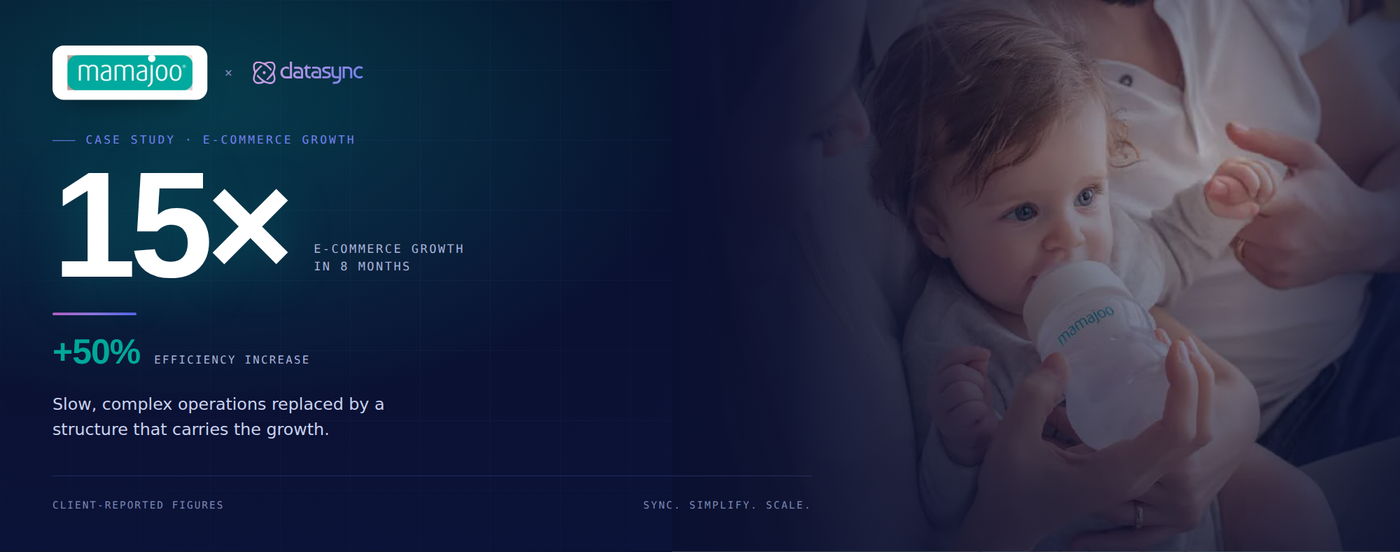
Before DataSync our operations were slow and complex, and could not support our growth. With DataSync’s SaaS and support infrastructure we achieved 15x e-commerce growth in 8 months and increased efficiency by 50%. DataSync became a strategic partner for sustainable growth.

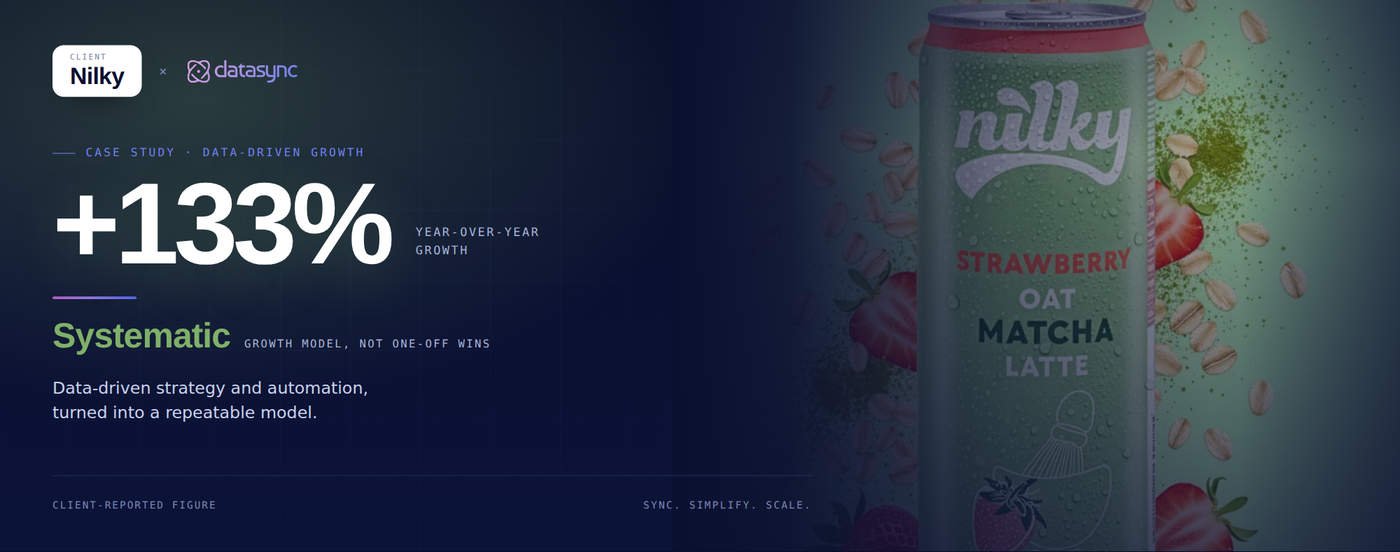
Working with DataSync was not just using software — it was gaining a growth partner. The team understood our needs and delivered sustainable solutions. Data-driven strategies and automation raised our efficiency and produced 133% annual growth. DataSync made our growth systematic.
Every other Tuesday: what actually moved in commerce AI, which platform changes matter this month, the tools we are testing, and what is shipping inside SYNC AI. Short, specific, written by the team doing the work.
What the models are genuinely good at this quarter — and where confidence still collapses on real operational data.
Marketplace policy shifts, channel economics and the numbers behind what mid-market commerce teams are actually doing.
New tools, protocols and integrations we are testing internally — with an honest verdict on whether they are ready.
What shipped, what we learned building it, and how the intelligence layer is changing behind the scenes.